



[2026.10 Update] Starting November 1, 2026, the new fixed rate is 1.40%, and the inflation component is 4.08% on an annualized basis. Together, they produce a composite annual rate of 5.51% for the first six months on newly purchased I Bonds. The inflation component is nothing extraordinary, but the fixed rate, modest as it may look, is the highest in twenty years! Once you buy, that fixed rate stays with your bond for up to 30 years, while the inflation component adjusts with inflation. This makes I Bonds worth considering again. See the “Recent Rate History” section below or this page for historical rates.
In recent years, U.S. inflation has been elevated, while rates on ordinary savings accounts have struggled to keep pace. That has been frustrating for people who would rather avoid the risks of investing in stocks or real estate. As official inflation readings rise, however, a previously unremarkable, relatively obscure product can become particularly attractive: U.S. Treasury Series I Savings Bonds, commonly known as I Bonds.
Product Overview
- Principal protection: Series I Savings Bonds are a special type of bond issued by the U.S. Treasury. Although they do not carry FDIC insurance like bank deposits, the risk of a U.S. Treasury default is roughly comparable to the risk of the FDIC system collapsing. In practical terms, they can be considered a principal-protected investment.
- How the interest rate is calculated: The rate consists of two components: a fixed rate and an inflation rate. The composite rate is calculated as follows:
Composite rate = [fixed rate + (2 x semiannual inflation rate) + (fixed rate x semiannual inflation rate)]
- A few notes on the rate calculation: Your fixed rate is determined when you buy the bond and remains unchanged for its entire 30-year life. The inflation rate varies with inflation data. Interest is compounded semiannually. New fixed rates and inflation rates are announced every six months, on May 1 and November 1. Note that these are the announcement dates: an existing I Bond’s inflation rate changes every six months from its issue date, rather than on the announcement date. One additional point: the inflation rate can be negative during deflation, but the composite rate has a floor of 0% and cannot be negative.
- Current rate: See the “Recent Rate History” section below.
- Purchase limit: The limit is tied to your Social Security Number (SSN). You can buy up to $10,000 per SSN per calendar year. The limit resets on January 1 each year.
- Holding period: I Bonds have a 30-year life, but you can cash them in at any time after holding them for one year. If you cash them in before five years, you forfeit the last three months of interest.
- How to buy: Individuals buy directly through TreasuryDirect. No brokerage or retirement account is required. This also explains why you rarely hear banks or retirement plan providers promote I Bonds: they cannot earn management, advisory, or transaction fees from them.
- I Bonds cannot be traded on the secondary market.
- You can defer tax on the interest until redemption.
- Interest is subject to federal income tax but is exempt from state and local income taxes.
For more information, see the official TreasuryDirect pages:
- Product overview: https://www.treasurydirect.gov/indiv/products/prod_ibonds_glance.htm
- Interest rate calculation: https://www.treasurydirect.gov/indiv/research/indepth/ibonds/res_ibonds_iratesandterms.htm
- Buying savings bonds: https://www.treasurydirect.gov/indiv/research/indepth/ibonds/res_ibonds_ibuy.htm
- I Bonds vs. TIPS: https://www.treasurydirect.gov/indiv/products/prod_tipsvsibonds.htm
Recent Rate History
How to Buy Series I Savings Bonds
Purchase I Bonds through the official TreasuryDirect website:
The website looks like it came straight out of the 1990s, but it is a government website, after all. If this is your first time using it, you will need to open an account.
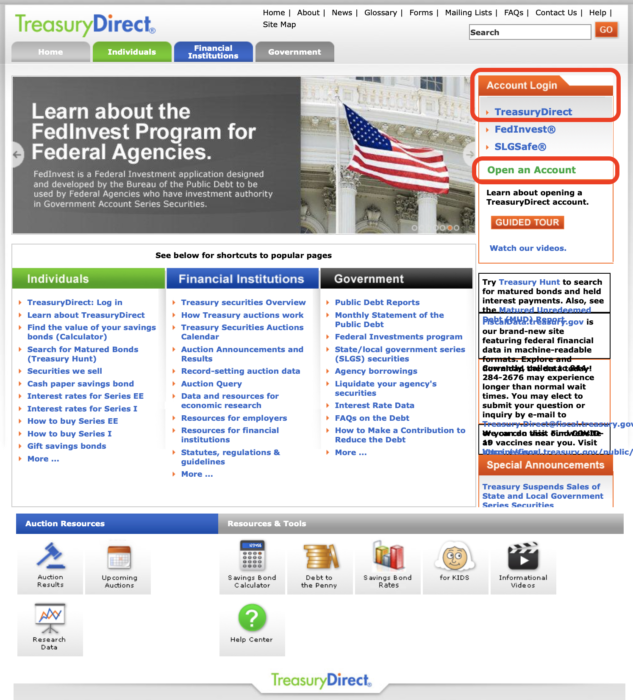
You will be asked to provide various personal details during registration. Most fields are straightforward, but one deserves a quick explanation: if you are opening an individual account, enter your SSN in the “Taxpayer Identification Number” field.
Some people may receive an error saying that their identity could not be verified. We discuss this situation in a separate section below. To avoid verification delays that could prevent you from buying I Bonds before December 31, we strongly recommend opening your TreasuryDirect account first, even if you have not yet decided whether to buy.
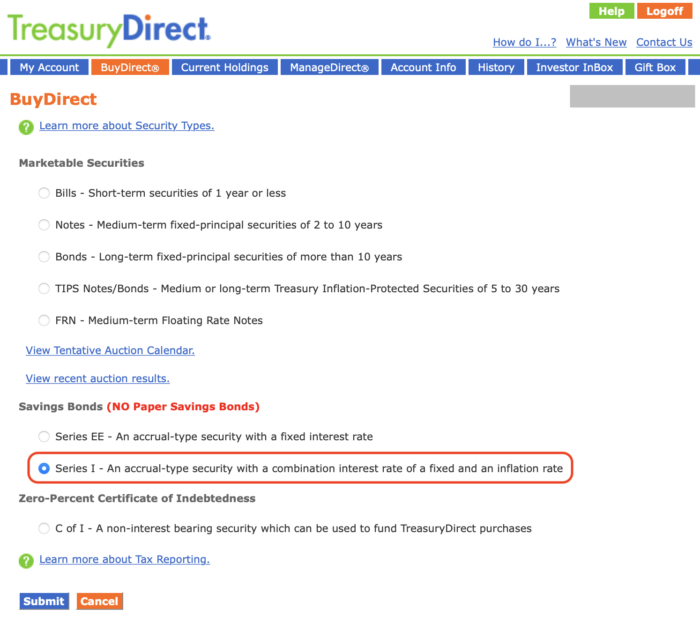
Once your TreasuryDirect account is ready, sign in and select the “BuyDirect” tab. You can purchase I Bonds using the option circled in red below:
How to Cash In (Redeem) Series I Savings Bonds
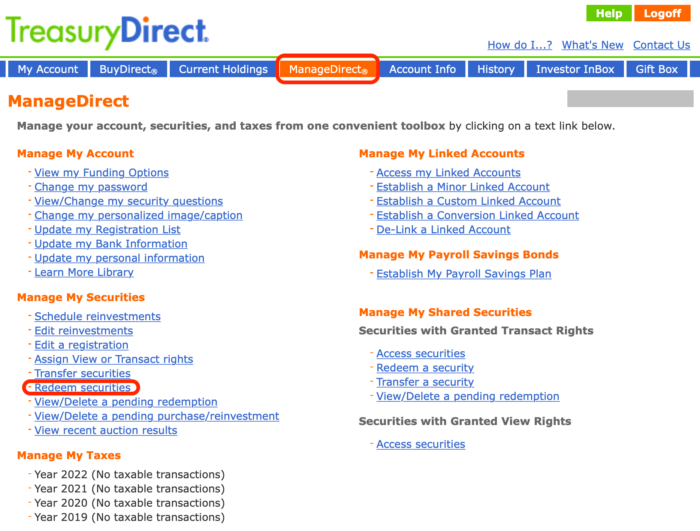
The process is simple, although the website makes it harder to find than it should be. Select “ManageDirect,” then “Redeem securities,” as shown below:
Who Can Buy Series I Savings Bonds?
You must have an SSN. In addition, you must meet one of the following conditions:
- United States citizen, whether you live in the U.S. or abroad
- or United States resident
- or Civilian employee of the United States, no matter where you live
As for how “United States resident” is defined, my understanding is that a Resident Alien (RA) should qualify, while a Non-Resident Alien (NRA) probably would not.
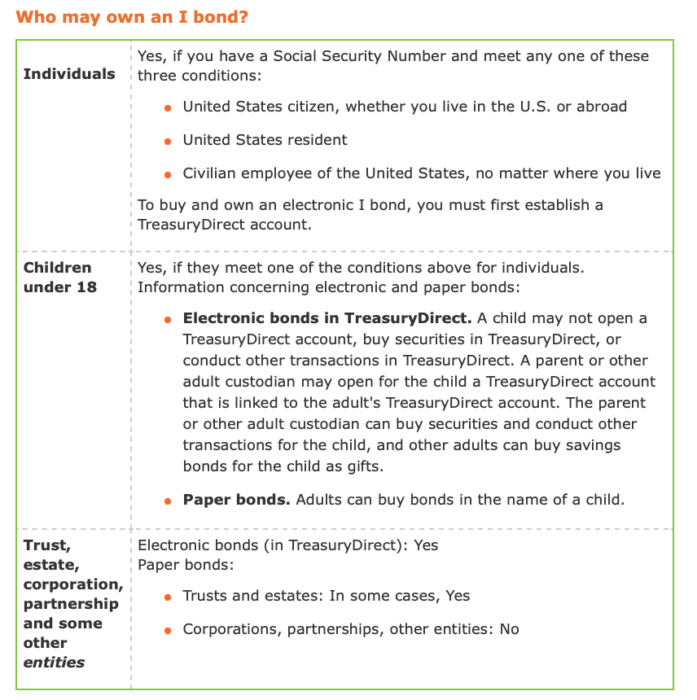
Children with an SSN are also eligible, and parents can buy I Bonds for them.
Corporations and trusts with an Employer Identification Number (EIN) are also eligible to purchase I Bonds, although we will not go into those arrangements here.
What If TreasuryDirect Cannot Verify Your Identity?
Some applicants may run into an identity verification issue when opening a TreasuryDirect account. The error message reads:
Thanks again for opening a TreasuryDirect account. We are having difficulty verifying the information you provided when opening your account. For your protection, please complete the Account Authorization form https://www.treasurydirect.gov/pdf/rs/acctauth.pdf and mail it to Treasury Retail Securities Site, P.O. Box 7015, Minneapolis, MN 55480-7015. A hold has been placed on your account that will prevent you from accessing your account. After we receive and approve the Account Authorization form, the hold on your account will be removed. When you log into your account, check the Investor InBox section of your Treasury Direct account for an important message.
In this situation, follow the instructions on the form and visit a bank to have a manager certify your signature. A few points from the form’s instructions deserve emphasis:
- You must sign in the bank manager’s presence. Do not sign the form ahead of time.
- You need to complete this at a bank or credit union, rather than with a notary. Many bank employees are unfamiliar with the requirement and may assume you are asking for notarization. Make it clear that you need a bank manager rather than a notary.
- Mail the completed form to the address specified in the instructions.
Based on personal experience, most bank employees have no idea what this form is. Ask them to read its instructions carefully, and emphasize that you need a bank manager rather than a notary. If someone at the counter says the bank cannot handle it, do not let that put you off: every bank can do this, so ask to speak with the manager. It appears that only one person at a branch may be authorized to use the required stamp, so you may need to find the branch manager to get it done.
After mailing the completed form, you may need to wait about two weeks before you can use your account. This is another reason to open your account early.
Summary
U.S. Treasury Series I Savings Bonds are a relatively niche savings option. They were not especially attractive in the past, but when inflation runs high, their rates can stand out and provide some protection against inflation. The $10,000 annual purchase limit per person is relatively small, but if you have spare cash and would rather avoid investing in stocks or real estate, I Bonds are worth considering.